Visit EHI website:

Showing posts with label EHI and The Handbook of Humanistic Psychology. Show all posts

Wednesday, July 9, 2014

EHI's Orah Krug and Troy Piwowarski are Contributing Authors to The Handbook of Humanistic Psychology

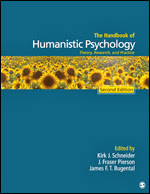
The Handbook of Humanistic Pyschology 2nd Edition Cover

EHI and The Handbook of Humanistic Psychology - EHI Contributor Profiles

The Handbook of Humanistic Psychology

Theory, Research, and Practice Second Edition


Edited by Kirk J Scheider, J Fraser Pierson and James T Bugental
Sage Publications, 2014


This post features the contribution of Orah Krug, EHI's Clinical Director and Troy Piwowarski, Student Outreach Coordinator with Editor J Frasier Pierson and Jeffrey G Sharp, a presenter at EHI:7 conference.

Chapter 41 

Cultivating Psychotherapist Artistry: Model Existential-Humanistic Training Programs
J Pierson, Orah Krug, Jeffrey Sharp and Troy Piwowarski


This chapter presents the reader with a perspective on what it means to cultivate therapeutic artistry from an existential-humanistic (E-H) lens.  At the heart of E-H therapy training is attending to the therapist-student as a genuine person who is the instrument of the therapy.  This chapter demonstrates two training models that illustrate how the person of the therapist is woven into the fabric of the learning experience.  The first model is based on Jim Bugental's Art of the Psychotherapist training, a model that emphasized students' learning of how to cultivate presence to the subjective world of themselves and their clients.  The second model is the Existential Humanistic Institute's certificate training program, which trains small groups of students and practicing therapists through a combination of theoretical learning and first-hand practice at experiential retreats.  Each of these models are illustrated not only by the theory behind their implementation, but by direct student feedback about what was most poignant.

This Chapter was chosen as one of the sample chapters for the Handbook - You can read Chaper 41, Cultivating Psychotherapist Artistry: Model Existential-Humanistic Training Programs here in PDF form. In this chapter EHI's certificate programs are included as one of the models of training programs highlighted in the article.

Orah T. Krug, Ph.D., is a licensed psychotherapist with a private practice in Oakland, and Sausalito, CA. She is a faculty member of Saybrook University, an editor for the Journal of Humanistic Psychology, and the clinical training director of the Existential-Humanistic Institute of San Francisco. EHI has recently launched a new Modular Training program and three certificate programs, one in partnership with Saybrook University that offers a Certificate in the Foundations of Existential-Humanistic Practice. Dr. Krug co-authored a textbook with Dr. Kirk Schneider entitled, Existential-Humanistic Therapy, part of a monograph series for the American Psychological Association and is  is a co-author of the above chapter in the second edition of The Handbook of Humanistic Psychology entitled "Cultivating Psychotherapist Artistry: Model Existential-Humanistic Training Programs."  She has produced two videos entitled, Conversations with Jim and "Joe" A Demonstration of the Consultation Process, with James Bugental. Her current research focuses on the relationship between existential meaning-making processes and therapeutic change. Dr. Krug may be reached at info[at}ehinstitute.org Attention: Orah Krug.

Read Orah's Presentation at DIV32 6th Annual APA Conference 2013:

The Renewal of Humanism: Lessons from an Existential-Humanistic Training Program - PDF


Troy Piwowarski, Psy.D. Candidate, LLP is an Existential-Humanistic psychotherapist currently complete his doctorate in clinical psychology at the Michigan School of Professional Psychology in Detroit. He had previously been working with elders at AgeSong, an assisted living community with E-H roots in the Bay Area.  As a doctoral student, Troy is passionately exploring what the E-H perspective has to offer, and is investigating through his dissertation how phenomenologically-minded therapists attune to their clients as persons-in-context.  He has published one article on Terror Management Theory entitled "The Effects of Mortality Salience and Belief in Afterlife on the Manifestation of Homonegativity," is a co-author of the above chapter in the second edition of The Handbook of Humanistic Psychology entitled "Cultivating Psychotherapist Artistry: Model Existential-Humanistic Training Programs" and has assisted in editing two books by EHI President Nader Shabahangi.
Troy has been collaborating with the student outreach team as EHI launches its newest training program this year. He currently acts as student outreach coordinator for EHI, and is available to discuss questions regarding the certificate tracks and training programs.

Thursday, May 29, 2014

Kirk Schneider, EHI Vice President & Senior Editor of The Handbook of Humanistic Psychology

The Handbook of Humanistic Pyschology 2nd Edition Cover

EHI and The Handbook of Humanistic Psychology - EHI Contributor Profiles

This blog series highlights an EHI faculty member and/or an EHI affiliated contributing author to The Handbook of Humanistic Psychology.

The Handbook of Humanistic Psychology

Theory, Research, and Practice Second Edition

Edited by Kirk J Scheider, J Fraser Pierson and James T Bugental
Sage Publications, 2014


This week's profile post features Kirk Schneider and his chapter on Rediscovering Awe. Here is an excerpt:

Chapter 6
Rediscovering Awe: A New Front in Humanistic Psychology, Psychotherapy, and Society, Kirk J Schneider

“I…remember moments that I have been awe awakened; [these were] times that I have been carried out of myself by something greater than myself and to that something I gave myself.”
--Martin Luther King, Jr. (1998, p. 28) from a paper submitted at Crozer Seminary, March 28th, 1951.

Preamble

The purpose of this chapter is to describe an emerging psychospiritual paradigm that veers between dogmatic fundamentalism and postmodern nihilism. This “depth” spirituality is based on a rediscovery of our native capacity for awe, and addresses the very fulcrum of our contemporary lives. It is a spirituality informed by the existential-theological tradition of great political leaders such as Martin Luther King and Mahatma Gandhi,  and by great philosophers, such as Soren Kierkegaard, Paul Tillich, Ernest Becker, and Rollo May.  This “awe-based” psychology, moreover, welds the zeal and exaltation for religion with the scrupulosity and skepticism of science. Drawing from my recent books Rediscovery of Awe: Splendor, Mystery, and the Fluid Center of Life (Paragon House, 2004) and Awakening to Awe: Personal Stories of Profound Transformation (Jason Aronson, 2009), as well as both film and literature, I explore the nature, power, and therapeutic implications of the spiritual capacity for awe.

Introduction

What if I told you that you are about to embark on a great adventure; that “you, are about to experience the awe and mystery that stretches from the inner mind to The Outer Limits,” a la the science fiction television show from the early 1960’s (Stefano, 1963).  But seriously, what if I told you that you are about to experience the terrors and wonders of the cosmos on this adventure; that you will be fully equipped for the journey; and that you will have about eight decades to proceed on it.  Further, what if I told you that you will encounter many fascinating events, sensations, and relationships on this journey, and that every day you will have a chance to marvel at, be moved by, and to imagine an entirely new way to live?
And—here’s the clincher—what if I told you that at the end of the eight decades there will be another, even more enigmatic and fascinating journey.  Would you want to go?   Would you do everything you could to savor the integrity of the entire trek? Would you want to kill, or rape, or devalue yourself or others in the face of this trek? Or stuff yourself with food, or drugs, or “reality” TV? Probably not; at least if sane or sober. Yet this is precisely what we seem bent on doing in our western, industrialized enclave: to defy the awe of living—the humility and wonder, thrill and anxiety of living—and the capacity to be moved.
Excerpt from Chapter 6 in The Handbook of Humanistic Psychology (2nd Edition) Copyright 2014 Sage Publishing Co. All Rights Reserved

What is Awe? In this video series Dr Lisa Firestone interviews Dr Kirk Schneider for the PsychAlive network and he discusses "What is Awe?" and "Developing Awe in Existential Psychotherapy."

What is Awe?


Developing Awe in Existential Psychotherapy


 See more of Dr Lisa Firestone's interviews with Dr Kirk Schneider on PsychAlive Channel >>


Kirk J. Schneider, PhD, Kirk J. Schneider, Ph.D., is a leading spokesperson for contemporary existential-humanistic psychology. Dr. Schneider is recent editor of the Journal of Humanistic Psychology, vice-president of the Existential-Humanistic Institute (EHI), and adjunct faculty at Saybrook University, the California Institute of Integral Studies, and Teachers College, Columbia University. A Fellow of the American Psychological Association (APA), Dr. Schneider has published over 100 articles and chapters and has authored or edited ten books (all either have been or soon will be translated into Chinese). These books include the recent publications of The Polarized Mind and The Handbook of Humanistic Psychology.  Dr. Schneider is the recipient of the Rollo May Award from Division 32 of the APA for “Outstanding and independent pursuit of new frontiers in humanistic psychology” as well as the “Cultural Innovator” award from the Institute of Living, Toronto, Canadaa psychotherapy training center which bases its diploma on Dr. Schneider’s Existential-Integrative model of therapy, and an Honorary Diploma from the East European Association of Existential Therapy. Dr. Schneider is also a founding member of the Existential-Humanistic Institute in San Francisco, which in August, 2012 launched one of the first certificate programs in Existential-Humanistic practice ever to be offered in the U.S.A. In April, 2010, Dr. Schneider delivered the opening keynote address at the First International (East-West) Existential Psychology Conference in Nanjing, China, and has been repeatedly invited to speak at various similar venues in China—as well as Japan--over the last three years. He is slated to deliver an opening keynote at the First World Congress of Existential Psychotherapy in London in May, 2015.

Visit Kirk's website >>

Kirk's recent book The Polarized Mind, is available through University Professors Press  >>

Read Dr. Schneider's blog Awakening to Awe at PsychologyToday.com.>>

Follow Kirk on Twitter >>

Find more Kirk Schneider resources on his EHI bio page

Related Posts: 

Check back for more upcoming posts on "EHI and The Handbook of Humanistic Psychology."

Wednesday, April 30, 2014

Nader Shabahangi, EHI President and Contributing Author to The Handbook of Humanistic Psychology

The Handbook of Humanistic Pyschology 2nd Edition Cover

EHI and The Handbook of Humanistic Psychology - EHI Contributor Profiles

This blog series highlights an EHI faculty member and/or an EHI affiliated contributing author to The Handbook of Humanistic Psychology. This week's post features Nader Shabahangi and his chapter on Humanistic Elder Care.

Why Humanistic Eldercare? Read this excerpt from Nader's contributed piece to get a preview of Ch.16 Humanistic Eldercare: Toward a New Conceptual Framework for Aging.
"The present conceptual framework used in the way we look at aging and the way we care for our elders is demeaning and harmful to our elders and to the well-being of our societies at large. Yet, from large to small eldercare corporations and businesses, this outdated framework and understanding continues to disgrace and devalue our elders. In contrast to this outdated and harmful attitude stands an existential-humanistic, process-oriented approach. Such an attitude regards aging and old age as purposeful. It understands caring – whether it is receiving or giving care – as essential to our humanity; and it regards the many symptoms of aging and old age as meaningful guideposts to be understood rather than made into problems and/or pathologies.

This attitude opposes the present mainstream idea of aging, old age and care for elders where aging is understood as a disease, old age as a phase to be avoided and basically useless, and the many symptoms associated with aging and old age as meaningless problems in need of treatments and cures. Even recently added concepts such as successful and healthy aging use longevity and physical health as basic measures of what are deemed successful and healthy. These concepts of aging and care are most often based on biologically quantitative and normative measures of human life. This means that measurements and standards to which those measurements are compared form the basis of evaluating a human being’s life, that is whether a person, for example, is performing, declining, successful, smart, healthy, or diseased."


What is Humanism in Elder Care? Watch this video of Nader Shabahangi speaking with AgeSong Interns where he discusses "The New Theory of Eldercare" and the focuses, methods and practices of a humanistic eldercare community.

The New Theory of Eldercare with Nader Shabahangi Part 2


 See both Part 1 & 2 of the New Theory of Eldercare here in the AgeSong Video Library >>


Nader R. Shabahangi, PhD, received his doctorate from Stanford University and is a licensed psychotherapist. His multicultural background has made him an advocate for different marginalized groups of society throughout his adult life.

In the 1980's he worked with abused children and teenagers and led anticipatory bereavement groups for Coming Home Hospice. In 1992 he founded the non-profit organization Pacific Institute with the purpose of training psychotherapists in a multicultural, humanistic approach to counseling and to provide affordable therapy services to the many diverse groups living in San Francisco. In 1994, noticing the often inhumane treatment of the elderly living in institutions, he started to develop an innovative Gerontological Wellness Program in order to provide emotional support and mental health care services for the elderly. In 1997, together with his two brothers, Nader opened a residential care home for the elderly in San Francisco called Hayes Valley Care, where he could along with the Pacific Institute Internship team implement the Gerontological Wellness Program.


View Nader's EHI Biography >>

See Nader's Work with AgeSong  >>

View Nader's Work With Pacific Institute  >>

Read Nader's Blog, Nader's Musings >>

Find Nader's Next Speaking Event here on the AgeSong Calendar >>

Related Posts: 

Check back for more upcoming posts on "EHI and The Handbook of Humanistic Psychology."

Tuesday, April 8, 2014

E Mark Stern Remembered


In Memorium:  Mentor, Friend, “Father” Mark Stern


(Excerpted from eulogy delivered by Kirk Schneider at St. Paul’s of the Apostles Chapel, New York City)

There are so many things I could express about my dear friend, mentor, paternal inspiration, Mark.  I could express to you my sentiments about his complex, beautiful mind that wove complex, beautiful, if wildly wonderful elliptical, prose. His wondrous stories of the early days of psychoanalysis and humanistic psychology—the wild people he and Virginia knew intimately, the life of being awake, alive, adventurous,  of how we were instantly attracted to/appreciative of one another—the bond somewhat enigmatic at first yet quickly realized in each other’s shared skepticism/cynicism about our profession, the world of politics, and the world of Spirit—and yet equally, passionately I could convey our shared wonder, marvel, and indeed awe toward each of those and more, so much more.  I could share with you my admiration of how deeply Mark cared for those whom he loved,  such as his wife Virginia and his family.  I can’t count the number of times he spoke so admiringly of you and how much he relished seeing Virginia blossom in the local and regional political scene.  (He was SO proud of you, Virginia—and I saw how he so enjoyed those raucous party meetings and debates). And finally, I could share with you our delight on meeting at APA and the Div. 32 Conf some twenty plus years ago, the visits to Bare Farm (where Mark and Virginia lived)—the Hudson River painter Fredrick Church's Olana house, Bard college, Vasser College (and our radio gig on Awakening to Awe), the Rubin museum, Silvia’s Soul Food Restaurant in Harlem, Columbia, Mark’s keynote and last visit, including a wonderful accompaniment to the local SF play “Under the Lintel Tree” starring his friend and neighbor David Straithorn, being regaled by a flood of stories and memories of Mark’s kaleidoscopic  past.  But I think Mark’s vibrant, eloquent words say it all:
From an email to a close colleague on our Division listserve: 
“I guess I was born to take the pathway of the darker soul of the night.  Such seemed to be an almost basic requirement for the depth psychologists of the mid-20th century.  My plight was to listen as much to the doleful and misty of my patients and myself.  Dreams, symbols, metaphors, murky associations a sense of unconscious unity with all—these were foundational to a psychology of the soul.”
On his very personal and therapeutic experience of awe from our book Awakening to Awe:  
“Awe is in one special sense, the excitement of participation.  Translated into process, awe befriends depth psychotherapy—not by promising to remove all pain, rather by addressing (with reverence) the pained person; not by eradicating his conflict.  Instead by paying attention to the role of friction and combat as the exile’s resolve to cross the desert;  not by encouraging the positive, more by paying attention to who one is…”
~ Kirk Schneider, March 22, 2014, New York City


EHI warmly remembers Dr E Mark Stern and recognizes his extensive personal and professional contributions in advancing humanism in psychology and psychological therapies. He taught and touched many people in his career and life who shall go on to continue expanding the field of humanistic therapies. He will be greatly missed.


EHI was very honored to have the late Dr E Mark Stern as Opening Keynote Speaker for the EHI:7 Annual Conference this last November. His address is shared here as a PDF. Dr Stern also recently contributed the foreword to the 2nd Edition of The Handbook of Humanistic Psychology.

You can read a recent article by Dr Stern, Inflections, from the Society of Humanistic Psychology Newsletter (October 2009) where he "Examine(s) the vision of humanistic psychology with a brief history of Jan Smuts, Victor Frankl and Jacob Levi Moreno and their missions."

Also read about Dr Stern in the History of APA DIV 32 [PDF] by Christopher M. Aanstoos, Ilene Serlin, Thomas Greening.

E. Mark Stern was 2014 recipient for Award for Distinguished Lifetime Contributions to Humanistic Psychology given to an individual in recognition of distinguished lifetime contributions to humanistic psychology.


Monday, March 31, 2014

Introduction to EHI and The Handbook of Humanistic Psychology by EHI's Vice President, Kirk Schneider, PhD

A Blog Series Introducing EHI Faculty and Their Contributions to the Second Edition of The Handbook


The Handbook of Humanistic Psychology 2nd Edition
Edited by Kirk J. Schneider, J. Fraser Pierson and James F. T. Bugental
Sage Publications, February 2014


For this new edition of The Handbook of Humanistic Psychology, there have been 13 new chapters and sections added, along with some 23 new contributors. Among these contributors are several from EHI including myself, Orah Krug, Nader Shabahangi, Ilene Serlin, and Troy Piwowarski. Major developments in humanistic theory, research, healthcare, eldercare, multicultural psychology, neuroscience, developmental psychology, awe-based spirituality, social and political psychology, and psychotherapy have all been vividly and methodically detailed. Moreover, the volume addresses key controversies that are brewing both within and without humanistic psychology. Among these are the withering pressures on mainstream psychology to shift further from its humanistic roots and to cater to military-industrial interests, the pressure on humanistic and general psychotherapy to stress short-term, solution focused interventions and the pressure on psychology as a whole to become a STEM (science, technology, engineering, and mathematics) discipline.

EHI and The Handbook of Humanistic Psychology

EHI would like to present a series of posts on the EHI contributors to The Handbook of Humanistic Psychology and give visitors a look at the humanistic work that EHI professionals are doing in their fields; in practice as well as in education and outreach.

The series EHI and The Handbook of Humanistic Psychology is part of our ongoing series on  EHI Professionals found here on the EHI blog.

Find out more about the 2nd Edition of The Handbook of Humanistic Psychology and Order your personal copy today -SAVE 30% - Download the information Book Flyer with Special Offer!

View even more details on the Sage Publications page.